Srebrenik’s Silver Sentinel: A Traveler’s Journey Through Castle, Lake & Legend
November 15, 2025
Key Takeaways:
-Srebrenik Fortress is a well‑preserved medieval stronghold built high on a rocky hill in northeastern Bosnia and Herzegovina.
- It played an important strategic role in defending the region and was first mentioned in historical records in 1333.
-Today the fortress is a national monument and offers visitors panoramic views and a sense of history.
Updated March 27, 2026
Estimated Reading Time: 12~14 min
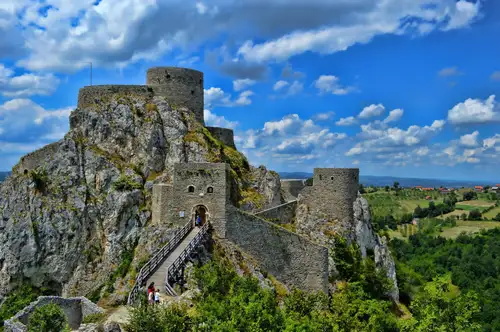
Rising proudly from the northeastern slopes of Majevica Mountain, the medieval Srebrenik Fortress (Tvrđava Srebrenik) is one of Bosnia and Herzegovina’s most evocative historical landmarks. Perched on a nearly inaccessible rocky outcrop some five kilometers from the town of Srebrenik, it commands sweeping views over the Tinja River valley and surrounding hills.
The earliest known mention of the fortress dates to 1333, in a charter issued by Ban Stjepan II Kotromanić, underlining how long this site has watched over the land. Its strategic importance was no accident: located along vital medieval military routes, Srebrenik played a key role in defending the Bosnian state from incursions.
The Stone Watcher on Majevica
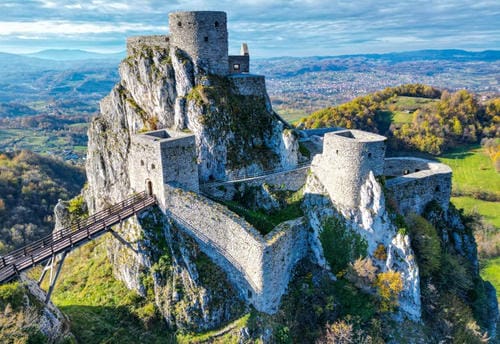
Architecturally, the fortress is compact but formidable. Measuring approximately 60 meters by 30 meters, it includes four towers, a residential building, a cistern, and ample defensive walls almost 1.5 meters thick. The rock upon which it is built rises steeply — about 50 to 70 meters above the valley floor — and a deep ditch, carved beneath the most reachable side, renders the fortress all but impregnable. Access is granted only via a bridge suspended over the trench — a medieval defensive trick, and in past centuries, the bridge could be removed to thwart invaders.
Historical shifts in power left their marks on Srebrenik. Over centuries, it passed among Bosnian, Hungarian, Serbian, and Ottoman rulers. In 1363, a Hungarian army, led by Nicholas Kont, suffered heavy losses at Srebrenik. The fortress changed hands multiple times in the 1400s, including rule under King Sigismund of Hungary, Serbian Despot Stefan Lazarević, and Hungarian King Matthias Corvinus.
By the early 16th century, the Ottomans had taken control of Srebrenik. During Ottoman rule, one of the towers was converted into a mosque, a symbol of how the fortress continued to serve both military and civilian functions. While its strategic importance waned over time, the fortress was periodically repaired — notably around 1756 — before being finally abandoned as a military garrison around 1835.
In the 20th century, the fortress fell into disrepair but later underwent significant conservation and restoration. A major restoration between 1975 and 1978 stabilized key structures, and in 2003, a more solid access bridge was built, making it safer for visitors. On November 2, 2004, Srebrenik Fortress was officially declared a national monument of Bosnia and Herzegovina.
Myths, Legends & Silver Dreams
Srebrenik is more than stone and mortar — it's a place rich in legend, mystery, and a sense of timelessness. The very name “Srebrenik” is said to derive from the Bosnian word srebro, meaning “silver.” One enduring folk tale involves three queens who competed to build the most magnificent city: the queen who founded Srebrenik declared that her city should “shine like silver,” hence its name.
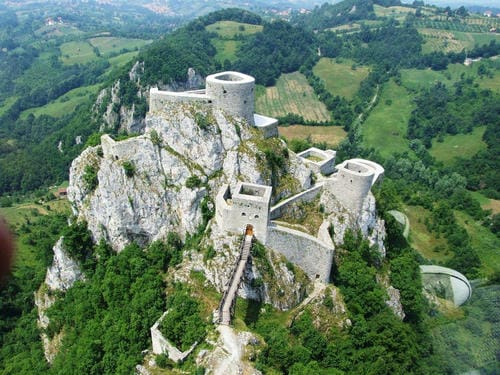
Over centuries, the fortress has borne witness to the rise and fall of rulers, but its physical isolation gives it a somewhat fairy-tale quality. Mist often drifts through the valley, cloaking the fortress in a soft veil that makes its towers appear almost ethereal. Local storytellers speak of Bosnian bans and kings who once walked its ramparts, of armies that besieged it, and of whispered secrets hidden in its shadowed corridors. In the Middle Ages, the fortress was a border stronghold — a guardian against Hungarian ambitions, and later, a node in Ottoman defensive networks. These geopolitical tensions shaped not just the walls but the identity of the place. While the fortress’s military function diminished over time, its mythic aura has only grown stronger: for many visitors, Srebrenik feels timeless.
Some say the Ottoman-era mosque inside the fortress was once a sacred place not just for worship, but for reflection — a miniature sanctuary perched high above the valley, where the outside world felt very far away.
A Traveler’s Pilgrimage to Srebrenik
Visiting Srebrenik Fortress today is more than a sightseeing trip — it's a meditation on history, nature, and legend all blended into one. The approach itself feels like part of the journey: narrow, winding roads climb through the hills to the village of Gornji Srebrenik, then steep steps or rugged footpaths lead up to the fortress. The relative remoteness means that parking is limited, and signage isn’t always abundant, so travelers often arrive on foot or after a short but careful drive.
Crossing the bridge into the fortress is a moment of quiet drama. Below is the deep trench that once prevented invaders; above rise the stone towers, steep cliffs, and bits of masonry threaded with history. Inside, visitors can explore the surviving towers, the courtyard, the cistern that once stored rainwater, and the residential building — perhaps once used by Bosnian rulers or Ottoman garrisons.
The fortress offers spectacular panoramic views. From the ramparts, you can gaze out over the Tinja valley, spot distant fields and forested hillsides, and feel the isolation that made this castle so defensible. It’s a place to pause, breathe, and imagine the many lives that once unfolded here.
Because there are no shops, restaurants, or cafés inside the fortress grounds, visitors are wise to bring water, snacks, and sturdy footwear. Also, accessibility is limited — the terrain is rocky and steep, and some paths may be difficult for those with limited mobility.
Guided tours are available and recommended. Local guides often bring the place to life, recounting political intrigues, battles, restoration efforts, and local legends. Their stories — of Bosnian bans, Ottoman soldiers, and queens dreaming of silver — help visitors connect deeply with Srebrenik’s layered past.
The site is generally open to visitors for a modest entrance fee. Because of its quietness and atmospheric position, many travelers combine a visit to Srebrenik Fortress with hiking along the Majevica hills, exploring nearby villages, or simply relaxing in the countryside.
Looking ahead, there are efforts to further promote Srebrenik as a tourism destination. Local authorities and the tourist board are exploring ways to digitize content, mark hiking trails, and develop ecotourism initiatives in the Majevica region. Increasing visibility could help more travelers discover this hidden gem while ensuring that its medieval charm and natural surroundings remain preserved.
Srebrenik Fortress is not just another historic site — it’s a living monument carved into rock, steeped in legend, and still resonant with the echoes of kings and queens, armies and architects, faith and fortitude. For any traveler to Bosnia seeking depth, beauty, and a touch of mystery, it offers a journey through both time and terrain.
(Travel involves risks. The author is not responsible for any injuries, losses, or damages that may occur while following advice, itineraries, or suggestions provided on this blog. Always exercise caution and follow local rules.)
About the Author:
Julian Rivers is a seasoned travel writer and former global tour director, specializing in sustainable travel and cultural immersion. He has explored more than 60 countries and consulted for international travel publications.
References:
https://ijmrap.com/wp-content/uploads/2022/12/IJMRAP-V5N6P112Y22.pdf
https://visitbih.ba/en/the-old-town-of-srebrenik-home-of-bosnian-bans-and-kings
Curious for more? Our blog has stories and guides that take you from bustling cities to tranquil retreats. Keep exploring—you never know which article will spark your next adventure!