Wandering the Heart of Bolivia: High-Altitude Springs, Salt Flat Illusions, and Andean Villages
November 17, 2025
Estimated Reading Time: 12~14 min
High in the Andes Mountains, stretching across southwestern Bolivia, this land seems shrouded in mystery. Here, the forces beneath the earth operate silently yet powerfully: mineral-rich water gushes from the ground, forming icy pools that create crystal-clear soda springs, bubbling gently as if alive. These springs, sometimes called "salt eyes" (ojos de sal), gush from the hard crust of the salt flats, hinting at the geological structures hidden beneath. Remote guides describe them as "very cold and mineral-rich," windows into the tectonic movements that shaped this region.
A Landscape of Whispering Springs and Mineral Veins
But the plateau's charm extends far beyond this. In the remote Eduardo Avaloa Andes National Wildlife Reserve stands the Soldemaniana geothermal field—a place so extraordinary it seems as if the earth itself is dreaming. At nearly 4,900 meters above sea level, steam vents hiss, mud pools boil and churn, and fumaroles spew sulfurous steam into the thin, acrid air.
This pristine, natural environment is part of a vast volcanic system; jeep tours often stop at what locals call the "Devil's Cauldron," where pressure escapes from a hole in the ground, spewing steam columns up to 50 meters high.
The altitude here is not just a number — many of the springs lie at elevations above 4,000 meters, and the air is thin, sharp, and unyielding. A journey to find these hidden waters is a kind of pilgrimage, one that demands acclimatization, patience, and respect. Visitors often feel the raw power of the landscape keenly: wind-swept plains, scattered salt, and the constant reminder that you are on a high plateau where the sky meets the earth in startling clarity.
(Image from OnMyCanvas, the copyright belongs to the original author)
The Endless White Mirror of the Salt Flats
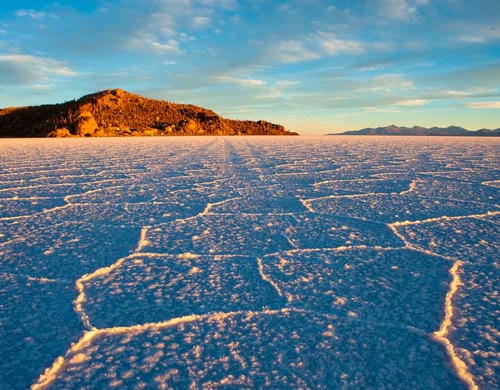
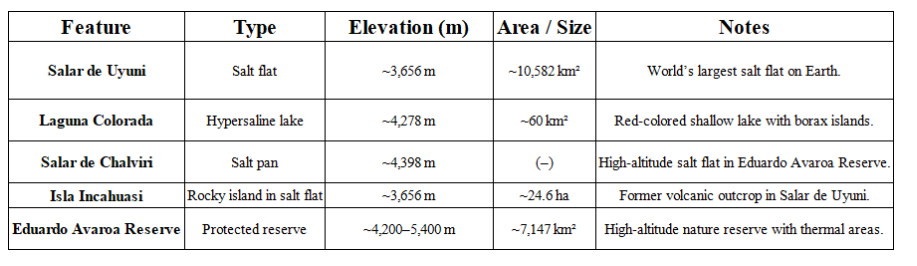
Beyond the hidden springs, the soul of this landscape is laid bare in the Salar de Uyuni — the world’s largest salt flat, an immaculate plane of salt crust so vast it feels almost unfathomable. Covering over 10,500 square kilometers, it stretches across Bolivia’s Potosí and Oruro departments, perched at an elevation of roughly 3,656 meters.
Here, geometry and nature conspire in dazzling fashion. In the dry season (April to November), the surface cracks into intricate hexagons, a shimmering white puzzle laid across the altiplano. During the wet season (December through March), that same expanse transforms into a boundless mirror, a shallow film of water reflecting the sky so perfectly that horizons vanish and the world seems to double in height and depth. [1]
But the salt flats are more than a flat-plane spectacle. Natural islands like Isla Incahuasi — once the top of a sunken volcano — rise dramatically out of the salt, dotted with gigantic cacti that look almost prehistoric. Nearby, salt-block hotels built entirely out of salt offer a surreal place to rest, where even the walls, beds, and tables are carved from the very ground beneath your feet. [2]
(Image from Travelgrafia, the copyright belongs to the original author)
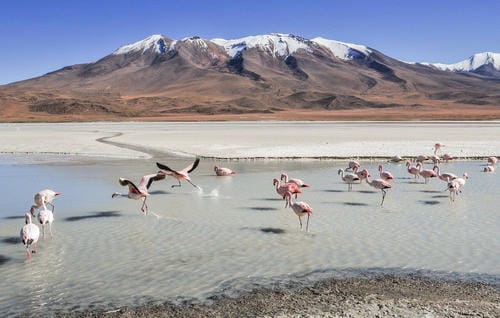
Nearby, hidden salt pans like Salar de Chalviri lie quietly, fed by hot mineral springs. The thin crust of salt contrasts with the scalding orange waters just below the surface, and gelatinous microbial mats coat the edges, creating textures and colors that seem almost painted. These remote lagoons draw wildlife: vicuñas and llamas graze nearby, and if you pause long enough, the subtle crests and swirls of the landscape feel alive, as if the earth itself were breathing.
Touring the salt flats usually happens on multi-day 4×4 expeditions, where guides navigate white plains, stop for dizzying optical illusions, and lead travelers to remote features: salty lagoons, geyser fields, and high-altitude rock formations. The iconic Train Cemetery, on the outskirts of Uyuni, is one such stop — a rusting cluster of steam locomotives, abandoned and silent, relics of a bygone mining era.
Touring the salt flats is typically done in multi-day 4×4 expeditions. Guides drive over that pristine white crust, stop at vantage points for perspective-defying photos, and lead travelers to remote lagoons and geysers. One highlight is the Train Cemetery on the outskirts of Uyuni — a quiet, rusting graveyard of steam locomotives, silent monuments to an era of mining and transport long past. [2]
Quiet Villages Where Time Moves Differently
Surrounding this otherworldly terrain are humble Andean communities — tiny villages perched on volcanic hills, or tucked away in the folds of the plateau, where life continues at the pace of the wind and the seasons. On a 4×4 expedition through the Eduardo Avaroa Andean Fauna National Reserve, travelers often pass through hamlets like Quetena Chica and Quetena Grande, sitting at altitudes of around 4,000 meters.
These local villages are not tourist traps but living communities. Their traditions are grounded deeply in this high-altitude world: llama herding remains a way of life, and medicinal plants are harvested to treat common ailments like altitude sickness. At night, under skies that feel impossibly close, people chew coca leaves or brew coca tea — customary practices that help with the thin air and ease the body into broken sleep.
Some of the most fascinating human stories unfold in places like Santa Rosa, a remote rural settlement in the foothills of the Andes. According to descriptions of the village, there are no paved streets, no mains services, and basic communication relies on solar-powered radio. The rhythms of daily life there — working at high altitude, tending animals, navigating isolation — remind visitors that these lands have long been shaped by resilience, not tourism.
Further into the region, on the edge of the salt flats, lies Colchani, a tiny town often overlooked in guidebooks but central to the salt-production economy. [2] In Colchani, salt bricks are handmade and refined, and local markets sell souvenirs fashioned from salt itself. There are also small museums that showcase the salt extraction process and the traditional ways of working with this mineral-rich region.
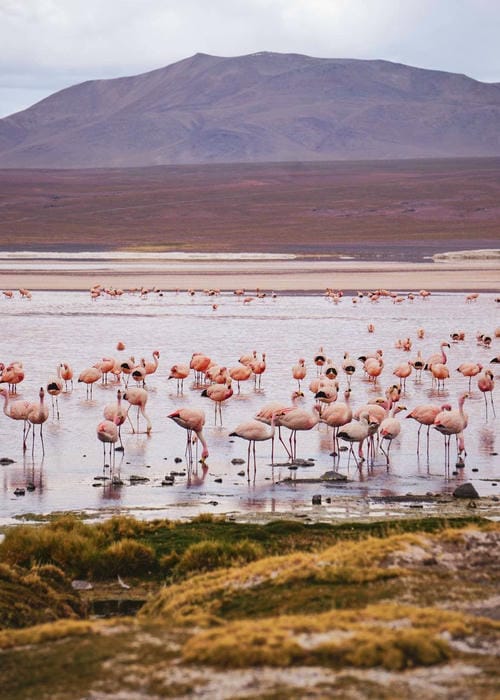
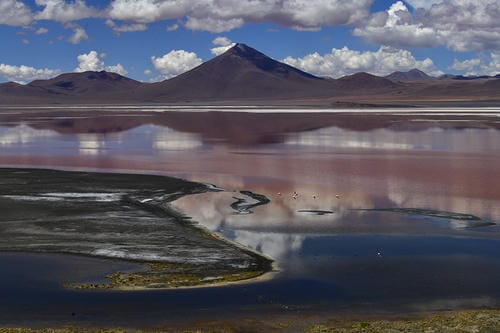
Not far beyond the flats, landscapes deepen into solitude and color. It’s here, in the Eduardo Avaroa National Reserve, that Laguna Colorada glows red under the Andean sun — a hypersaline lake painted by pigmented algae, starkly contrasting against pale salt and bright skies. Flamingos gather at its margins, and jagged borax deposits form ghostly white islands.
Traveling through these remote Andean villages, you may feel as though you are walking through a dream made real: cactus-dotted hills, ancient volcanoes, mineral springs, salt flats that stretch to infinity, and communities whose lives embody the fierce, fragile beauty of this plateau world.
Photographers and adventurers often say that their most unforgettable moments come at dawn or dusk. At those times, on the salt flats, the light slants low and long, revealing reflections so perfect they seem unreal. On volcanic ridges or around remote lagoons, the fading sun brings out banded colors — rust, ocher, emerald — in the hillsides. In such moments, you don’t just travel through the Altiplano; you become part of it.
Post by Julian Rivers
Sources:
[1]: https://remote-expeditions.com/travel-guide/best-places-to-visit-in-bolivia
[2]: https://southamericabackpacker.com/salar-de-uyuni
References:
https://explorewithkathy.com/2025/03/14/adventure-uyuni-salt-flats-and-bolivias-desert
https://www.pachaexpeditions.com/blog/experience-the-magic-of-the-uyuni-salt-flats-expert-recommendations-for-travelers
Don’t stop now! Your next travel idea is waiting in another post!