Zamość’s Living Chessboard – A Stroll Through a Renaissance Designer City
November 18, 2025
Updated March 27, 2026
Estimated Reading Time: 10~12 min
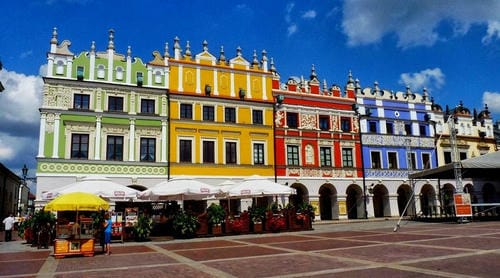
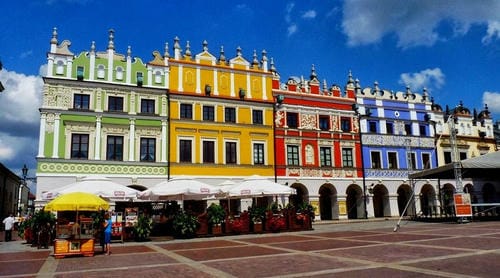
Tucked away in southeastern Poland lies the remarkable city of Zamość — a micro-town that feels more like a living game board. Founded in the late 16th century as a planned bastion town and designer city, Zamość was built on the ideals of the “ideal city” of the Italian Renaissance and laid out with striking regularity and symmetry. [1]
Its street grid, squares and axes give the sense of a giant chessboard — straight lines, right angles, repeating blocks of homes and shops. As you walk the town, it invites you to imagine yourself as both spectator and participant in a larger strategic game — one of commerce, design and defence.
For the travel writer or wanderer looking for something off the usual path, this is a gem: a compact city where every turn feels deliberate, and where the logic of planning is as much part of the experience as the architecture itself.
The story begins in 1580 when Chancellor Jan Zamoyski commissioned Venetian-trained architect Bernardo Morando to build a town in his estate. Morando designed Zamość around two main axes intersecting at the Great Market Square, surrounded by arcaded merchant houses, a town hall with a tall tower, and a cathedral rising nearby.
The layout is both efficient and symbolic — the palace to the west, the town to the east; the main streets crossing like a ‘+’ and smaller streets radiating out like the arms of a board game.
Walking its cobbled streets, you sense the logic of the plan: every street leads somewhere purposeful, every block fits into a larger order. Staying overnight enhances the feeling: with fewer day-trippers, the quiet old town allows you to sense the chess-like geometry of the place — plazas, corners, vantage points, fortifications.
Sculpture and Sanctuary: The Cathedral and Artistic Heart
Amidst the meticulously planned streets of Zamość, one of the most arresting sights is the town’s cathedral — the Zamość Cathedral (formerly the collegiate church) built between 1587 and 1598.
The cathedral rises not only as a spiritual centre but as a sculptural and architectural focal point in the city’s design. Its tower dominates one of the axes; its façade is elegantly composed; its interior radiates Renaissance and early Baroque detail. Visitors describe the cathedral’s significance both for its artistry and for its place in the town’s layout. [2]
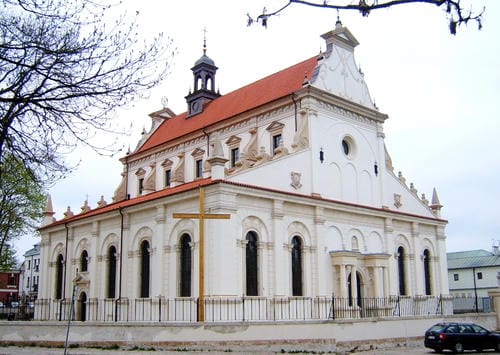
Inside, the high altar, sculptural elements and ornate chapels invite close inspection. In a city so consciously planned, the cathedral becomes the pause in the game board — the moment to pivot, to reflect, to take in the sweep of the architecture around you.
You might capture how the cathedral frames the experience: from the flight of stairs leading up to its portal, the views down the main axis, the play of light on sculpted stone, and how it anchors the many symmetrical streets around it. At dusk, as the light softens, its towers and spires add vertical drama to the otherwise horizontal, grid-like town.
From the perspective of a visitor seeking something beyond the typical “town with a cathedral,” Zamość offers a layered experience: the cathedral is not just a religious or tourist stop, but a sculptural piece set into the game-board town, one that invites contemplation within the larger design of the city.
Rolling Your Move Across Zamość’s Grid
Think of Zamość as a board game you walk rather than play seated. Begin your turn at one of the gates of the old town and commit to one of the long, straight streets that slice through the grid. As you move forward, you’ll discover that the layout is no accident — every axis, every vanishing line of buildings, every open square is part of a larger plan.
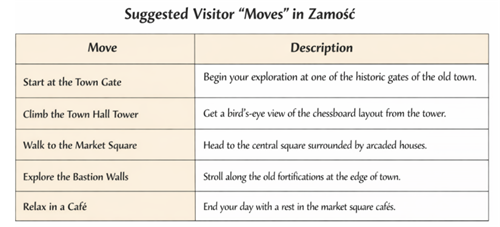
Vary your moves through time as well as through space. In the early morning, when cafés are still setting up and the light stretches across the façades, take your first move. Around midday, delve into one of the major monuments — perhaps the cathedral or a museum — and let the rhythm of the town slow down. As evening comes, the shadows lengthen, lights glow, and the bastion walls take on a dreamlike presence.
Because Zamość’s old quarter retains its original Renaissance plan almost intact, with minimal large-scale post-war alteration, you’re walking through the same grid lines laid down centuries ago. Therefore staying overnight isn’t just practical—it’s strategic. After the day-tour crowds leave, you’ll have the board to yourself: the empty squares and quiet arcades allow you to sense the full pattern of the town in calmer tranquility.
As you wander, think of your path as a scorecard of moves: start at the palace side, advance toward the heart of the market, retreat to a side street, pivot toward a bastion, stop at a viewpoint looking back across the grid. Notice how corners catch your eye, how the long axes draw you in, how the fortification edges frame the town like the boundary of a game board.
Invoke sensory details: the crisp clarity of straight-on sightlines, the echo of your footsteps in the arcaded passageways, the warmth of the evening light softening the pastel façades, the quiet turning of a comer when you cross from one axis to the next.
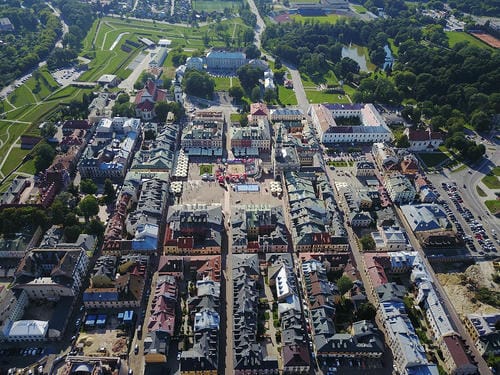
Mention also the practical logistical “moves”: start your wander early, aim for the town hall tower for a vantage-point move (look down on the grid), then follow one of the long straight streets outward toward the bastion walls for a move that reaches the edges of the board. Return along a side street for a diagonal retrace, and complete your exploration with café time in the market square as the “endgame” move.
By framing Zamość as a travel game board, your blog can invite readers to step consciously into movement—not just seeing the town, but playing it. The architecture becomes the rules, the street grid your field of play, and every decision about which way to turn becomes part of the narrative.
(Travel conditions, visas, entry requirements, and restrictions can change without notice. The author is not responsible for complications arising from changes in travel policies or events beyond their control.)
About the Author:
Leila Santos is a travel journalist with expertise in adventure destinations and eco‑tourism. Her work has appeared in multiple global outlets, and she has led expeditions across Latin America.
Sources:
[1] https://ormianskiepiwnice.pl/en/dlaczego-zamosc-to-miasto-idealne-historia-architektura-i-atrakcje-perly-renesansu
[2] https://www.curiousclaire.co.uk/guide-to-zamosc-polands-hidden-delight
There’s always more to discover—stick around for the next story!