Bagan’s Timeless Temples on the Ayeyarwady Plains
November 21, 2025
“Bagan’s temples rise from the plains as timeless storytellers, where centuries of devotion, artistry, and human ambition are etched in every brick and spire.”
Estimated Reading Time: 14~16 min
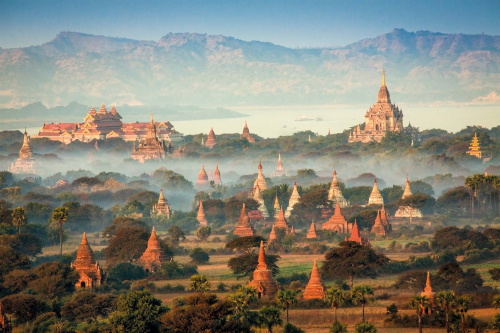
High on the wide, arid plains by the Ayeyarwady River, Bagan stands as a monument to human faith and artistic ambition. From the 9th to the 13th centuries, the Pagan Kingdom churned out more than 10,000 temples, stupas, and monasteries; today, about 2,200 of these structures remain scattered across the plain, their brick spires piercing the sky in silent testimony to a bygone era.
The temples here are not simply relics — they are living chapters of devotion. Kings and nobles built them both out of religious fervor and as a means to accrue merit, while artisans and monks infused them with deep symbolism. The architectural forms are bold yet elegant: terraces leading upward, cruciform bases, vaulted halls, and glazed tiles illustrating Buddhist narratives.
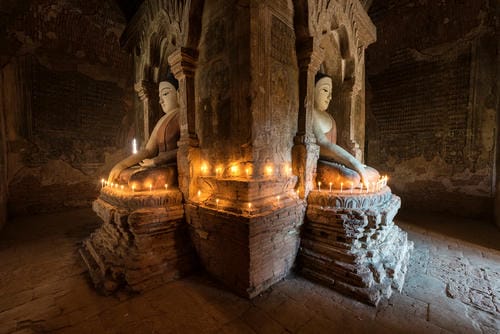
Walking the plain, one experiences the layering of belief, power, and time. The Ananda Temple, perhaps the most famous, stands with its four towering Buddhas, each facing a cardinal direction — a reminder of universal presence and the symmetry of the cosmos. Nearby, the Dhammayangyi Temple looms in its massive red-brick simplicity, built by a king who sought to atone for his sins. Thatbyinnyu Temple, the tallest in Bagan, rises five stories high, once housing monks, relics, and a monastery library.
The Spiritual Landscape of Bagan
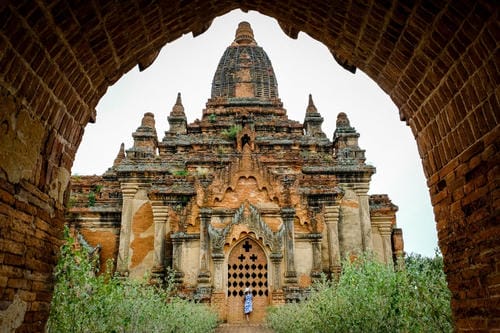
Temples like Mahabodhi, modeled on its namesake in India, with hundreds of Buddha niches, and Lemyethna, also known as the Temple of Four Faces, further enrich the architectural tapestry. Shwegugyi Temple, built by King Sithu I in the 12th century, blends fine stucco detail with graceful arched windows and carved wooden doors, showing a different facet of Bagan’s craftsmanship.
But these structures are not frozen in time. Many have been scarred by nature and history: earthquakes have cracked walls, heavy rains have weakened foundations, and past restoration efforts—sometimes hasty and not always faithful to original techniques—have left problematic imprints on the ancient masonry.
In recent years, natural disasters have increased the threat: flooding and relentless rain have seeped into fragile brickwork, eroding its strength. Compounding that, an archaeologist recently reported that as many as 1,900 pagodas are now in urgent need of repair. Conservation is underway, supported by UNESCO and international partners, but the challenges are profound.
At dawn or dusk, when soft light spills across the plain, the temples take on a haunting beauty. The air is cool, and shadows stretch long, bringing out the texture of each brick, the carved detail, the patina of age. It feels as though history is speaking softly, inviting reflection and wonder.
Stories Carved in Brick and Mortar
Each temple in Bagan is more than a structure: it is a story, a purpose, an imprint of human longing.
(Image from The World Travel Guy, the copyright belongs to the original author)
Take Ananda Temple, for instance. Built in 1105 under King Kyansittha, its cruciform design and tiered terraces are crowned with a hti (umbrella ornament), while inside, its four standing Buddhas mirror the cardinal directions — east, north, west, south — symbolizing a universal, omnipresent enlightenment. The temple also hosts an annual festival in the full moon of Pyatho, where thousands of pilgrims gather for chanting and gift offerings.
But not all stories are so serene. The Dhammayangyi Temple is the largest in Bagan, built during the reign of King Narathu (1167–1170). Chronicles suggest he built it to atone for violence — Narathu came to power by killing his own kin — and rumors linger that he even killed the craftsmen who worked on the temple to preserve its grandeur. Its interior, unusually, is sealed in brick, so visitors can only walk the outer corridors, adding a sense of mystery and unknowable interior.
Then rises Thatbyinnyu Temple, reaching about 66 meters in total height, constructed during King Sithu I’s reign around 1150. Its name means “omniscience,” symbolically related to the Buddha’s all-knowing insight. The temple once functioned not only as a shrine but as a center of learning: lower floors housed monks and relics, higher floors served as a library, a place of both study and worship.
There is also Mahabodhi Temple, inspired by the famous Indian site where the Buddha is said to have attained enlightenment. Built under King Htilominlo in the early 13th century, its architecture reflects Gupta-style influence, and it holds more than 450 Buddha images in its many niches.
Not to be overlooked is Lemyethna Temple, also called the “Temple of Four Faces,” completed in 1222. Built over an even older Pyu foundation, it symbolizes continuity — how Bagan’s spiritual identity was layered over earlier civilizations.
Beyond size and fame, smaller temples carry personal histories. Shwegugyi Temple, built in 1131 by King Sithu I, is known for its arched windows and detailed stucco work, and while less grand in scale, it offers a more intimate look at craftsmanship and devotion.
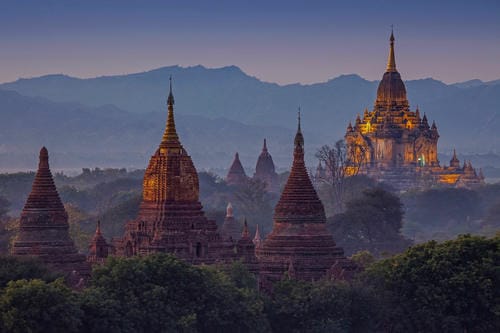
In every brick, every terrace, every carving, the temples of Bagan tell stories of kings seeking redemption, of artisans channeling their devotion into stone, of communities gathering across generations for festivals, prayer, and reflection. The plain is a living manuscript, where time is recorded in brick mortar, weathered stucco, and fading tiles.
Challenges and Resilience: Preserving a Fragile Legacy
No account of Bagan is complete without acknowledging the fragility of its treasures. The very nature of how these pagodas were built — unreinforced masonry, baked bricks, soft mortars — makes them vulnerable to the elements. [1] Over centuries, natural hazards like earthquakes have struck repeatedly. After a 6.8-magnitude earthquake in 2016, more than 400 temples were damaged, and restoration efforts remain complex and ongoing.
Restoration itself has sometimes been controversial. In past decades, quick repairs using modern materials were deployed without always respecting traditional techniques, leading to criticism from historians and conservationists. Flooding from heavy rains has become another severe threat: recent storms have weakened foundations, saturated ancient brick walls, and caused structural instability in many pagodas. An archaeologist recently warned that nearly half of the pagodas — around 1,900 — may now be at risk of collapse.
Despite such risks, preservation efforts are under way. UNESCO and international partners are working alongside Myanmar’s archaeological authorities to stabilize structures, repair damaged masonry, and safeguard the cultural landscape. Still, the work is delicate: heavy rainfall, decades of poor repair, and limited maintenance staff — made worse by political and resource challenges — continue to complicate conservation.
Yet, Bagan endures. The temple plain remains not only a major tourist destination but a deeply spiritual place. Locals and pilgrims still visit, candles are still lit, monks still chant, and visitors still rise before dawn to watch the sunrise glow off terracotta spires. These living practices breathe life into the ruins, reminding us that these temples are far more than relics — they are treasured parts of a shared human story.
(This blog reflects the author’s perspective and interpretation of different cultures and locations. Readers are encouraged to respect local customs and conduct further research to gain a full understanding.)
About the Author:
Elena Torres holds a Master’s in Cultural Anthropology and has worked as a heritage tourism consultant. Her deep understanding of local traditions and customs enriches every travel guide and destination review she writes.
Sources:
[1] https://www.nationalgeographic.com/history/article/myanmar-earthquake-religious-cultural-sites
References:
https://www.smithsonianmag.com/travel/the-architectural-wonders-of-bagan-11363805
https://www.cbsnews.com/sanfrancisco/news/6-8-quake-damages-scores-of-myanmars-heritage-bagan-temples
Stay a while! More adventures, tips, and stories are just a click away!