Golden Hours in the High Andes: Dawn and Dusk in the Atacama
November 20, 2025
“In the Atacama Desert, dawn and dusk transform an austere landscape into a luminous spectacle, where salt flats, volcanoes, and high-altitude lakes are painted by light and shadow, and the night sky unfolds in unparalleled clarity.”
Updated March 26, 2026
Estimated Reading Time: 10~12 min
Rising before dawn or staying until the last light fades above the Atacama Desert is nothing short of a spiritual journey. Located in northern Chile, this sweeping desert—one of the driest places on earth—brings light into spectacular relief: the first rays of sun breaking across salt flats, volcanic silhouettes at dusk, and the glow of twilight casting soft pinks and purples across arid rock. The desert’s arid clarity amplifies each moment when light shifts and transforms the landscape. Photographers consistently rank the region as essential simply because of the brilliance and subtlety of its light.
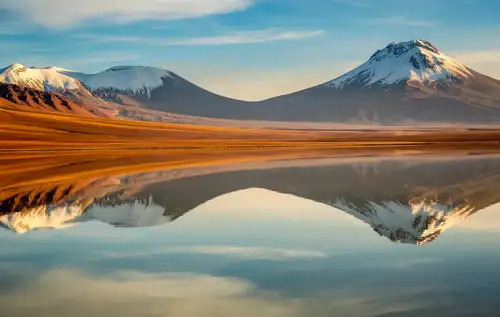
At the break of day, the high plains and elevated lakes—many situated above 4,000 metres in elevation—are bathed in the delicate glow of sunrise. The air is thin, cold, and crystal clear, lending each ridge and salt crust a sharpness uncommon elsewhere. One photographer wrote of camping high above the desert and witnessing dawn on volcanic peaks in “pure cold” and “windy” conditions, yet entirely worth the effort. [1]
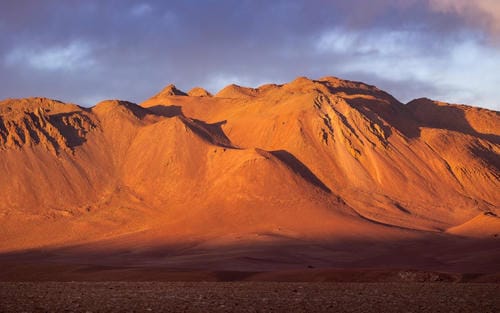
As the sun dips toward the horizon, the desert shifts yet again. What seemed a straightforward landscape becomes a canvas of subtle tones: ochre cliffs, white salt flats, lavender sands, the saffron glow of low-angle sunlight. One prime location is the Valle de la Luna (“Valley of the Moon”), near the oasis town of San Pedro de Atacama, where the setting sun defines ridges and salt formations while the sky washes pink, purple and finally deep blue.
For the travel-writer or photographer, chasing these moments in the Atacama presents logistical challenges and profound rewards. Elevation may leave you light-headed, winds may pound canvas or camera gear, and the terrain demands respect. But the light—unfiltered, shimmering, immense—is a reward few landscapes can match. Preparation matters: pack layered clothing for cold mornings and breezy evenings, bring sturdy equipment to capture long exposures, and schedule visits around the soft-light hours when shadows lengthen and the heat of midday light softens. As one guide notes: the extreme contrasts of bright sun and deep shadow demand technical precision.
Night Skies and Celestial Radiance
As the desert gives up its daylight glow, the heavens above the Atacama awaken in a way few places on Earth can match. The dry air, high altitude and near-absence of light pollution combine to make the region a globally celebrated site for astronomy and astrophotourism. Over 70 % of the world’s premier sub-millimetre and millimetre‐wavelength observatories are located in the region above the Atacama.
Travelers who stay past dusk often find themselves under a Milky Way so vivid it resembles a river of light pouring across the sky. One guide described this view as transformational, noting that unlike in urban areas where only a handful of stars are visible, here the galaxy’s texture and depth become plainly evident.
For those keen to capture the night sky, the desert offers exceptional conditions—but also unique demands. Expect frigid temperatures after sunset, particularly at higher altitudes, and bring gear suitable for long exposures: tripod, weather-sealed camera body, wide-angle lens and appropriate filters. The road to remote vantage points can be rough, and drone or aerial usage is highly regulated in national reserves. Planning ahead and travelling with local guides enhance both safety and the experience of finding vantage points almost devoid of other people.
Beyond photography, the night sky here has a cultural dimension. Indigenous Atacameño cosmologies interpret not just the stars but the dark spaces between them—seeing shapes such as the celestial llama “Yakana” in the dark patches of the Milky Way. Standing under that vast sky, the traveler senses not just isolation but continuity: of ancient humans gazing upward, of scientists unravelling cosmic mysteries, of a desert that both shelters and reveals the universe.
Beyond the Light: Terrain, Time and Travel Tips
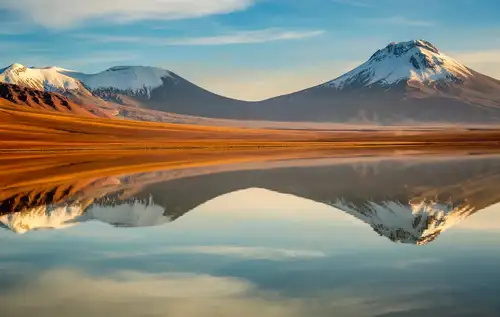
Seeing the light in the Atacama is inseparable from engaging with the terrain itself. Vast salt flats, rugged volcanoes, high-altitude lakes and geyser fields all serve as stages where light and land interact. For example, in the high altiplano near the town of San Pedro de Atacama, one photographer camped at an elevation of 4,500 metres at Laguna Lejía and experienced dawn light on volcanoes at over 5,500 metres. [1]
The region’s geological diversity means each spot offers its own light-show. The expansive Salar de Atacama salt flat reflects low-sun glow in still mornings; the rugged salt-rock formations of Valle de la Luna twist into long shadows at sunset; and high-plain lakes framed by snow-capped volcanoes mirror the sky in tranquil moments.
Travel logistics matter. Many of the classic vantage points are remote, involve high-altitude drives or require early-morning starts. For example, access to some remote lagoons may involve dirt roads, 4×4 vehicles and navigation aids like offline maps. [2] Seasonal timing also plays a role. The best light and sky clarity tend to occur in the shoulder seasons—spring or autumn—when the air is crisp, the sun’s angle flattering, and weather patterns stable. Holiday seasons or full-moon nights can reduce the drama of shadows and light contrast.
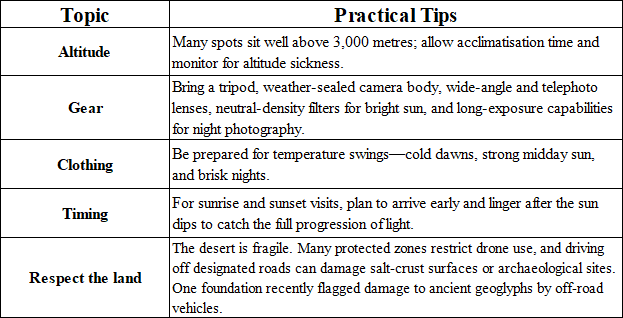
Practical Travel Tips
Ultimately, chasing light above the Atacama is about more than perfect photographs—it’s about immersive experience in a land of extremes. You witness the interplay of air, altitude, rock, salt, sky and time. You stand where light is uncompromised, where shadows are sharp and skies endless, where dawn and dusk feel like rites of passage. And when night falls, you look upward and find that the universe itself seems to bend closer, invited by the clarity of the desert air, ready to reveal its secrets.
About the Author:
Diego Alvarez is a professional travel videographer and digital nomad. Having worked with multiple tourism boards, he specializes in crafting immersive travel stories that showcase destinations through both visuals and words.
Sources:
[1]: https://www.mountainphotography.com/gallery/san-pedro-de-atacama
[2]: https://peterorsel.com/the-best-photography-spots-of-san-pedro-de-atacama-in-chile
Inspired? Our blog is full of travel stories you’ll love!