Whispered Tracks in the Deep Snow of Akita
November 15, 2025
Key Takeaways:
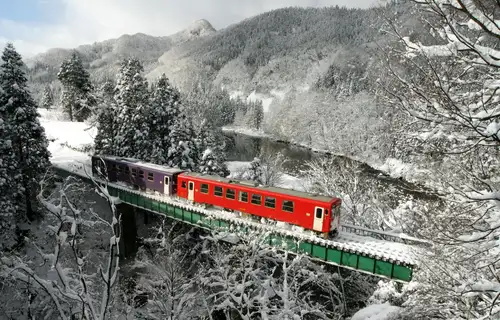
-The Akita Nairiku Line is a scenic rural railway in Akita Prefecture that runs about 94 km between Takanosu and Kakunodate.
-Nicknamed the “Smile Rail,” it offers beautiful views of countryside, mountains, and seasonal scenery from the train windows.
-The line connects 29 stations through unspoiled landscapes and is popular with travelers, especially during autumn foliage and winter snow.
Estimated Reading Time: 12~14 min
Winding through remote mountain ridges and broad rice-paddy plains in the heart of Japan’s Tōhoku region lies the evocative landscape of Akita Prefecture. Here, amid frosted forests and blanched fields, a single-track railway threads like a forgotten lifeline — the Akita Nairiku Line (nicknamed the “Smile Rail”) which stretches approximately 94.2 km between Takanosu and Kakunodate.
For the travel writer seeking more than postcard views, this is a journey into the echoes of lives once sustained by rail, into abandoned sidings, into quiet curves of track that speak of the hosts of workers, trains, and seasonal rhythms now faded. It is a ghost railway not in the sense of fantastical hauntings, but in the sense of what remains when modernity, depopulation and changing transport rendered some parts of rural rail lifelines.
Railways, Abandonment and the Rural Soul of Akita
Japan’s rail network is vast, and yet in recent decades many rural branch lines — once connecting small towns, mines, forestries and farms — have closed. An overview of closed railway lines in Japan lists several in Akita Prefecture. For example, the Akita Rinkai Railway Line, a freight-only line in Akita, shut down in March 2021.
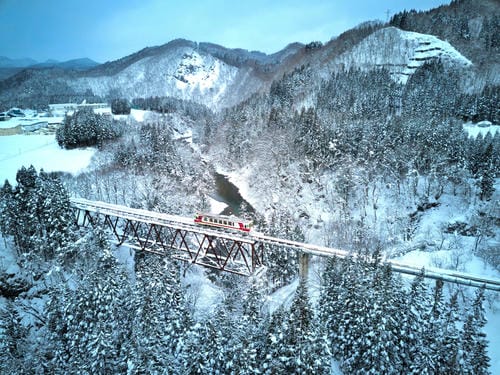
(Image from GaijinPot, the copyright belongs to the original author)
Though the Akita Nairiku Line itself remains operational, the same structural challenges that threaten many rural lines — declining ridership, aging infrastructure, fewer subsidies — are ever present. Enthusiast writers note that many stops on the line serve tiny populations, and some services are extremely sparse.
Walking through the countryside along parts of this line, one senses the faint outlines of platforms, the rust of disused sidings, the snow-weighed silence where once freight cars rumbled or local trains stopped. The railway becomes not just a means of transit but a symbol: a conduit for seasonal rhythms (the grain harvest, winter snow clearing), for community connection, for lives shaped by the arrival and departure of trains. Now, those rhythms have changed: fewer passengers, fewer stops, longer gaps in the timetable, stations lightly used or even unmanned.
For the traveler attuned to this layer of history, there is power in observing those leftover spaces — a closed ticket window, a station sign tilting in wind, a bridge echoing with no train sound, a railbed buried in snow. These are the “lost voices” of the ghost railway: the people whose commutes ended, the children whose daily ride ceased, the freight shipments once vital to local industry, the mine-hauling trains of decades past.
(Image from Good Luck Trip, the copyright belongs to the original author)
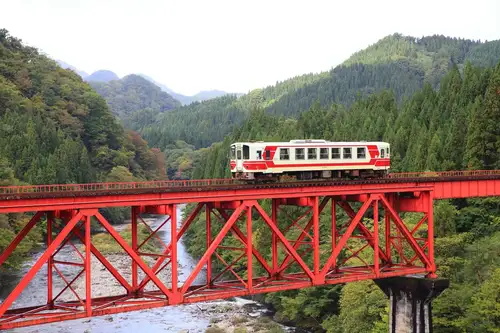
Yet there is paradoxical beauty here. The very fact that the line persists — against the odds — gives the landscape time to breathe, for nature to reclaim, and for the train ride to be slow, contemplative, deeply scenic. The official site describes it as a satoyama landscape between mountain foothills and arable flat land. A few notes for the traveller: take time to glance out of the window, to step off at small stations, to sense the shift in the hills and fields. In winter especially, when deep snow muffles surrounding sounds, the click of rail wheels, the faint engine hum, becomes profound. In autumn, the bridge over the Omata River offers a spectacular vantage of foliage, perhaps with just a handful of other passengers aboard.
Journeying the Line: Seasonal Echoes, Silent Stations
From Kakunodate, famous for its cherry-blossom lined samurai district, the Akita Nairiku Line begins its slow traverse inland. As one transitions from the rapid rails of the bullet-train era into this rural line, the pace alters, the windows widen, the journey becomes about falling into a rhythm.
In spring, the low angles of light reveal broad rice paddies freshly water-filled, reflections shimmering, the mountains making a quiet backdrop. The line passes through communities where wild edible plants emerge from the forest floor, and valley cabins cling to steep slopes. The official line-operator site notes the dogtooth violet blooms in April to May near Yatsu Station, for example.
Summer brings deep green, forested slopes, rice-field artwork visible from the train windows between July and September. The track winds over rivers, through tunnels, between ridges so narrow that you feel suspended between fields and peaks.
Then autumn arrives in full drama. One of the most celebrated views is the span of the Omata River bridge between Okashinai and Kayakusa stations, where the train becomes a window-box for crimson, orange and gold leaves rushing past.
In winter, the landscape silvers under snow. Villages near Ani ski resort provide frost-covered trees, the track winds along plains so white you feel suspended in time. The station building at Ani-Maeda Onsen has a hot-spring bath on the second floor to warm travellers.
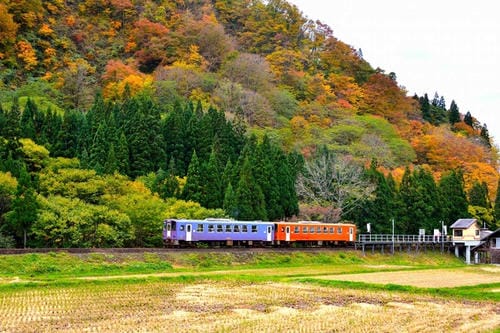
For anyone tracking the “lost voices” of the railway, there are moments when you alight at a low-traffic station, perhaps unmanned, look at the timetable listing only a few trains per day, wander around the platform, maybe find a sign of the past — a forgotten schedule board, an old sedan parked idly, snow half-covering the nearby waiting room. The silence becomes part of the story.
If you stop at Aniai Station, there is a small railway museum related to the Nairiku line history; walking around the surrounding community, one can sense the gradual ageing of the area: closed shops, fewer people, but also earnest local activity to preserve what remains.
Getting there is relatively straightforward: from Tokyo or Sendai you can reach Kakunodate by Shinkansen, then transfer. Choose windows seats, pick a slow schedule, and give yourself extra stops. Don’t rush: this is not just about reaching a destination but about inhabiting a memory-laden corridor of rail and rural life.
The ‘ghost’ element lies not in spectres but in what once was: days when factories hummed and mines shipped ore, when farms relied on the train for supply; now many of those functions are gone or replaced, yet the rails, stations, tunnels and bridges persist. Your ride becomes a mediation on change, on time, on community.
Tracking the old voices of this ghost railway in Akita means listening for what is no longer prominent — the absent commuters, the freight loads, the seasonal exodus of students, the engine whine now rare — and connecting that sense of absence with the vivid presence of landscape, quiet villages and a train winding through the foothills of a still-forgotten region of Japan.
(Travel conditions, visas, entry requirements, and restrictions can change without notice. The author is not responsible for complications arising from changes in travel policies or events beyond their control.)
About the Author:
Omar Nishimura is an award‑winning travel photographer and essayist focusing on remote landscapes. With over a decade capturing destinations from the Arctic to the Sahara, his writing brings destinations to life.
Before you go, take a moment to wander through our other articles! Each one is packed with travel inspiration, practical tips, and unforgettable experiences that might just ignite your next journey!